Monday, 31 October 2016

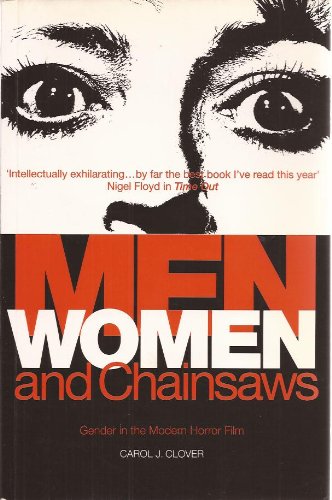
Men, Women and Chainsaws


Image result for Men women and chainsaws


Image result for Carrie
What does Clover mean by 'female victim-hero'?
Within the reading, Clover mentions a character type called the female victim-hero. In Men Women and Chainsaws, the character type is described as a monstrosity meaning that they are victimised by other people, which in turn makes the character act out heroically to battle those people who would have caused monstrous acts towards the character. However, in retaliation, she becomes the monster herself which makes her the victim-hero. Clover’s example of this is ‘Carrie’, Carrie is a girl who is victimised by her classmates who bully her, which in turn, causes her to act out in a monstrous way towards those who have hurt her making her the victim as well as the hero.


Why does Clover say that males relate to the females in horror films, in particular, the 'final girl'?
Within the book, Carol Clover states that “Pulling gym shorts down and thumb-rubbing glasses are things boys do to each other, not, by and large, things that girls do to each other or that boys do to girls”. What clover meant from this is that males share similar aspects to the final girl as they can relate to being victimised just like the final girl experiences. Due to being able to relate to the final girls experiences, this means that males tend to not relate to the antagonist of the film as they are the ones who conventionally humiliate the final girl whereas males tend to be on the receiving end.

Why does Clover suggest that horror research is problematic?
Clover suggests that Horror research is problematic due to the amount of analysis compared to the audience of TV. This is mainly because most of horror films produced are independent which means they are made less on the basis of audience statistics. However, research that has been carried out shows that the most common horror audience is young males (either in groups or their selves). As well as young males we also get some middle aged – middle class males and females who like to watch horror.

Who does Clover suggest makes-up the typical horror audience?
As clover has already stated, young males either within groups or by their selves make up the bulk of the horror audience. However, Clover states that there are a few groups who fill in the gaps of the audience such as adolescent girls/boys and middle aged women. Another influence that attracts audience is the sub-genre of the horror film which means the more mainstream the film is, the more normal the audience tends to be.

Was there parity between horror audiences in regards to those who watched horror films at the cinema and those who watched them at home through rentals?
Image result for CinemaAs Clover researched horror audiences, she saw a correlation between who watched horrors at home through rentals and who watched them on the big screen. The same as before, young males take up the bulk of the main audience within both of the situations as well as middle aged men and nearly all of both sexes were under the age of 25. Clover also states that the renter of said horror film is not necessarily the only watcher or even the actual watcher.

What are the two ways identified by Clover in which audiences identify with characters?
Within the book, Carol clover states that there are two possible ways that the audience are able to identify with the characters on screen. This can be done either with Primary Identification (which is the use of camera techniques) or secondary identification (with the character of empathic choice). Clover states that the identification can be personally constructed from the viewer’s psyche (e.g. the sadistic monster and masochistic victim). Carol proposes that primary identification carries more weight out of the two as it is significant in the way it connects characters. One theory that can back this is Mulvey’s ‘Male Gaze’ Theory. 

Sunday, 9 October 2016

Halloween (John Carpenter, 1978)

Image result for Halloween 1


1. How does the start exemplify a common technical code convention of the horror genre?
Horror films share a lot of common technical codes that are used frequently enough to become conventions. The start of the film exemplify's these with what the audience expects from the 'slasher' genre. One of these conventions is the sound track. The music is parallel which means it matches what is on screen so it enhances the experience of the viewing. Another common technical code is the use of the POV for restricted narration. This makes the audience more involved within the film as we watch the killer kill his sister from his point of view, this is conventional for the horror genre.                          
2. How does the setting fit with the horror genre
Image result for halloween john carpenter houseThe movie is set in a small suburban town in Illnois, America. Within the town there is everything that you would conventionally find within a horror setting such as large luxurious houses and a graveyard. This gives the representation of 'your own home' and how you're not safe in it. The small town also connotes that it is a little community and that everyone knows everyone which means anyone can be a victim. After Michael Myers kills his sister he is then admitted to a mental asylum and 15 years later he is still there. This gives the impression that Mike is still a dangerous person and when we see all the patients out on the field it connotes danger. This fits into the convention of horror showing that no where is safe. The time that the story is set is also conventional as it is Halloween night in which monster come back to life.

3. What iconography of 'innocence' do we hear or see early on?
Right at the start of the opening sequence we can hear children singing Trick or Treat which connotes innocence as children are seen as pure. We also see Laurie who is seen as the as the 'Girl Scout' and is the virginal character who is more interested in her studies rather that sex and boys like her other friends.

4. What was the main industry impact of Halloween
Halloween was very cheap to make, however from this it made lots of profit which lead to the creation of many sequels and copycats of the film. The reason that the film was so cheap was because they didn't use big stars who would have cost a lot to hire. The film also contained little gore so no special effects were needed.

5. Name some 'slasher' films which followed on from Halloween
  • Friday 13th
  • Prom Night
  • Terror Train
6. What are the four plot rules of the 'slasher' film sub-genre which Halloween began.
  • A traumatic event in the past which creates a psychopathic killer.
  • The killer returns to the site, usually on a specific date.
  • The killer stalks and kills a group of teens, conventionally with a blade.
  • A final girl survives who is boyish and a virgin.
Image result for Laurie halloween7. Give three ways in which Laurie is androgynous
  • Not interested in boys or sex
  • Has a deep boyish voice
  • Dresses boyish with no makeup
8. What does the extract mean by 'a reactionary sexual agenda'
A reactionary sexual agenda is when the virginal character survives compared to the ones who are sexually active who conventionally die. In other words those who have sex get punished. This can be directly related to the outbreak of AIDS and how people were dying for having sex.

9. How does the director, John Carpenter, counter the suggestion that Halloween had a reactionary sexual agenda?
John Carpenter however countered this argument by saying that they didn't die because they had sex but simply because they were distracted and weren't aware of what was happening around them. Throughout the film Laurie is always aware and we can tell this from here always being the one to see Mike Myers.

10. Why does Mike Myers kill his sister?
Within the film we never actually know why Mike killed his sister but from his doctor we are only able to hear him say that he is just pure evil and that he shouldn't be released from the mental asylum that he is kept at.